Simon Blackburn Powerful Ideas That Changed Modern Philosophy Forever
A Distinguished Philosopher Exploring Truth Ethics and Human Reason

Introduction
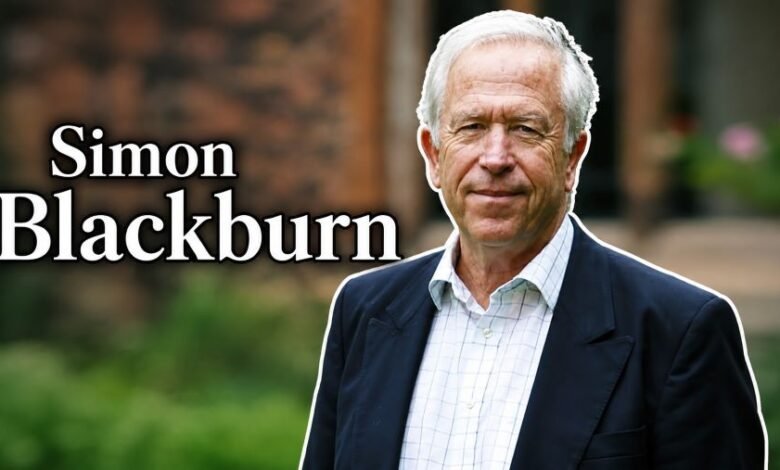
Simon Blackburn is an influential English philosopher whose work has shaped modern discussions about ethics, truth, philosophy of language, metaphysics, and the philosophy of mind. Born on July 12, 1944, in Chipping Sodbury, Gloucestershire, he developed an academic career that connected some of Britain’s leading universities with a wider international audience. His philosophical reputation rests particularly on his defense of quasi-realism and his continuing interest in how people make judgments about morality, truth, and reality.
Unlike philosophers whose work remains accessible only to specialists, Simon Blackburn has also devoted considerable effort to explaining difficult philosophical questions to ordinary readers. His books, lectures, interviews, and public discussions have helped introduce subjects such as ethics, metaphysics, Humean philosophy, and the nature of truth to a much broader audience. His career demonstrates the positive power of clear philosophical writing, while his debates about morality and religion also show how challenging philosophical ideas can provoke disagreement.
Quick Bio
| Category | Details |
|---|---|
| Full Name | Simon Walter Blackburn |
| Born | July 12, 1944 |
| Birthplace | Chipping Sodbury, Gloucestershire, England |
| Profession | Philosopher, academic, author, educator |
| Nationality | English |
| Main Fields | Ethics, metaphysics, philosophy of language, philosophy of mind |
| Known For | Quasi-realism, metaethics, philosophical writing |
| Education | Clifton College; Trinity College, Cambridge; Churchill College, Cambridge |
| Doctoral Work | The Problem of Induction |
| Major Academic Institutions | Cambridge, Oxford, University of North Carolina at Chapel Hill |
| Spouse | Angela Bowles |
| Children | Gwendolen and James |
| Major Honor | Fellow of the British Academy |
| Other Honor | Honorary Foreign Member of the American Academy of Arts and Sciences |
| Cambridge Position | Former Bertrand Russell Professor of Philosophy |
| Current Academic Association | Fellow of Trinity College, Cambridge |
The biographical information above is supported by Blackburn’s own biography and curriculum vitae, together with Cambridge and British Academy records.
Early Life and Education
Simon Blackburn was born in 1944 in Chipping Sodbury, near Bristol. His education began at Clifton College in Bristol, where he studied during the late 1950s and early 1960s. He subsequently entered Trinity College, Cambridge, studying Moral Sciences, a course that provided the intellectual foundation for his later career as a philosopher.
At Cambridge, Blackburn developed a strong interest in philosophical reasoning, logic, morality, and the problems surrounding knowledge. He completed his undergraduate studies in Moral Sciences and later pursued doctoral research at Cambridge. His PhD examined the problem of induction, one of the classic questions in philosophy concerning how people can justify conclusions drawn from previous experience.
Academic Career
Blackburn began his professional academic career at Churchill College, Cambridge, where he became a Junior Research Fellow in 1967. This early appointment placed him within one of Britain’s strongest philosophical environments and gave him an important starting point for his long academic journey. Two years later, he moved to Oxford, beginning a remarkable period at Pembroke College.
From 1969 to 1990, Blackburn was a Fellow and Tutor in Philosophy at Pembroke College, Oxford. During these years, his reputation grew internationally, and his philosophical work increasingly attracted attention beyond Britain. His academic interests developed across ethics, metaphysics, philosophy of language, and the philosophy of mind, establishing him as a wide-ranging philosopher rather than a specialist confined to one narrow field.
Move to the United States
In 1990, Simon Blackburn moved to the United States to become Edna J. Koury Distinguished Professor of Philosophy at the University of North Carolina at Chapel Hill. His American academic career expanded his international influence and gave him opportunities to engage with philosophers and students across different intellectual traditions.
His academic appointments also included visiting positions at institutions such as the University of Melbourne, the University of British Columbia, Oberlin College, Princeton University, Ohio State University, and the Universidad Autónoma de Mexico. These positions contributed to his international profile and reflected the broad interest in his work as a philosopher.
Return to Cambridge
Blackburn returned to Cambridge around 2000 and became the Bertrand Russell Professor of Philosophy while also becoming a Fellow of Trinity College. The appointment represented an important moment in his career because Trinity was also the institution where he had originally studied philosophy.
He retired from the Bertrand Russell Chair in 2011, but retirement did not mark the end of his philosophical activity. The British Academy identifies him as a UK Emeritus Fellow and records his continuing association with Trinity College, as well as visiting academic roles connected with the New College of the Humanities and the University of North Carolina.
Simon Blackburn and Quasi Realism
One of Simon Blackburn’s most important contributions to philosophy is his development of quasi-realism in metaethics. Metaethics examines the foundations and meaning of moral judgments, asking questions about whether moral statements describe objective facts and what it means when people say something is morally right or wrong.
Blackburn’s quasi-realist approach is associated with the idea that moral language can function in ways that resemble ordinary factual language without requiring philosophers to accept a straightforward form of moral realism. His work therefore occupies an important position in modern debates about moral objectivity, ethical language, and human judgment.
Influence of David Hume
Another important influence on Blackburn’s philosophy is David Hume. Blackburn has developed what is often described as a neo-Humean approach to several philosophical problems. Hume’s work on human nature, reason, morality, causation, and knowledge provides a major historical foundation for many of the questions that Blackburn continues to explore.
His interest in Hume is particularly visible in his book How to Read Hume, which introduces readers to Hume’s philosophical ideas while connecting them with broader questions about human reasoning. Through this work, Blackburn has helped demonstrate why an eighteenth-century philosopher remains relevant to modern debates about knowledge, morality, and human understanding.
Major Books by Simon Blackburn
Simon Blackburn has written extensively for both academic and general audiences. His first major book, Reason and Prediction, appeared in 1973 and was followed by works that increasingly established his reputation in philosophy.
His important publications include Spreading the Word (1984), Essays in Quasi-Realism (1993), The Oxford Dictionary of Philosophy (1994), Ruling Passions (1998), Think (1999), Being Good (2001), Lust (2004), Truth: A Guide for the Perplexed (2005), Plato’s Republic (2006), How to Read Hume (2008), The Big Questions: Philosophy (2010), Practical Tortoise Raising (2010), and Mirror, Mirror (2014). His books have been translated into more than 20 languages.
Think and Being Good
Among Blackburn’s most accessible books are Think and Being Good. These books helped establish him as a philosopher capable of communicating sophisticated ideas without making them unnecessarily difficult for general readers.
Think introduces major philosophical problems involving knowledge, mind, freedom, identity, and reality. Being Good focuses more directly on ethics and the questions people face when thinking about right and wrong. These works illustrate the positive side of Blackburn’s public philosophy: they make complex questions approachable while retaining the seriousness of philosophical inquiry.
The Oxford Dictionary of Philosophy
Another major contribution is The Oxford Dictionary of Philosophy. The work became an important reference source for students, researchers, teachers, and general readers interested in philosophical terminology.
Its importance extends beyond Blackburn’s own philosophical arguments because it helped organize and explain a large range of philosophical concepts. Later editions continued the work, demonstrating the lasting usefulness of the project in philosophical education and general reference.
Career Timeline
1944
Simon Walter Blackburn was born on July 12, 1944, in Chipping Sodbury, Gloucestershire, England.
1957–1961
He attended Clifton College in Bristol as a scholar.
1962–1965
He studied Moral Sciences at Trinity College, Cambridge.
1967–1969
He became a Junior Research Fellow at Churchill College, Cambridge, beginning his professional philosophical career.
1969–1990
He served as Fellow and Tutor in Philosophy at Pembroke College, Oxford.
1984–1990
He edited the philosophical journal Mind, an important scholarly publication in the field.
1990–2001
He served as Edna J. Koury Distinguished Professor of Philosophy at the University of North Carolina at Chapel Hill.
2000–2011
He returned to Cambridge as Bertrand Russell Professor of Philosophy and Fellow of Trinity College.
2001
He was elected a Fellow of the British Academy.
2008
He became an Honorary Foreign Member of the American Academy of Arts and Sciences.
2011
He retired from the Bertrand Russell Professorship while continuing his philosophical writing and academic activities.
2017
He became an Honorary Fellow of Churchill College, Cambridge.
Awards and Academic Honors
Simon Blackburn’s career has received recognition from major academic institutions. He became a Fellow of the British Academy, Britain’s national academy for the humanities and social sciences, and later became an Honorary Foreign Member of the American Academy of Arts and Sciences.
He also received an honorary LLD from the University of Sunderland in 1998 and an honorary DLitt from the University of Glasgow in 2011. His academic leadership included serving as president of the Aristotelian Society during 2009–2010, while his Gifford Lectures at the University of Glasgow further demonstrated his standing in philosophical scholarship.
Personal Life and Family
Simon Blackburn married Angela Bowles in 1968. His own curriculum vitae records that they have two children, Gwendolen, born in 1973, and James, born in 1975. These are the principal publicly documented details concerning his immediate family.
Blackburn’s personal interests have also included mountaineering, sailing, and photography. His earlier curriculum vitae lists these activities alongside reading and conversation, giving a small insight into the interests that existed beyond his professional life as a philosopher.
Public Philosophy and Humanism
A significant part of Blackburn’s later reputation comes from his willingness to communicate philosophy beyond university classrooms. His writing has been recognized for its clarity, and he has participated in public discussions dealing with truth, morality, consciousness, personal identity, science, and the nature of reality.
He has also been associated with Humanists UK and has served as a patron for the organization because of his contribution to humanist philosophy. His public discussions about morality and religion have sometimes been provocative, demonstrating that philosophy can challenge established assumptions as well as provide careful frameworks for understanding them.
Simon Blackburn in Modern Philosophy
Simon Blackburn occupies an important place in contemporary analytic philosophy because his work connects traditional philosophical questions with modern debates about language, morality, truth, and human reasoning. His philosophical approach draws on historical thinkers such as Hume while addressing questions that remain central to contemporary intellectual life.
His influence is especially visible in the way he combines specialized academic philosophy with accessible public writing. Rather than treating philosophy as an isolated academic discipline, Blackburn has consistently shown that questions about truth, goodness, reason, identity, and reality can be explored by anyone willing to examine assumptions carefully.
Conclusion
Simon Blackburn has built a distinguished career as a philosopher, educator, author, and public communicator. From his education at Cambridge and his years at Oxford to his work in North Carolina and his return to Cambridge as Bertrand Russell Professor of Philosophy, his career has crossed institutions and countries while remaining centered on philosophical inquiry.
His work on quasi-realism, ethics, philosophy of language, metaphysics, and Humean thought has made him an important figure in modern philosophy. At the same time, books such as Think, Being Good, and The Oxford Dictionary of Philosophy have helped bring philosophical thinking to readers outside specialist academic circles. His lasting contribution is therefore both scholarly and educational: he has defended challenging ideas while making philosophy easier for a wider audience to understand.
Frequently Asked Questions
1. Who is Simon Blackburn?
Simon Blackburn is an English philosopher known for his work in ethics, metaethics, philosophy of language, metaphysics, and quasi-realism.
2. When was Simon Blackburn born?
Simon Blackburn was born on July 12, 1944.
3. Where was Simon Blackburn born?
He was born in Chipping Sodbury, Gloucestershire, England.
4. Who is Simon Blackburn’s wife?
Simon Blackburn married Angela Bowles in 1968.
5. Does Simon Blackburn have children?
Yes, his two children are Gwendolen, born in 1973, and James, born in 1975.
6. Where did Simon Blackburn study?
He studied at Clifton College and Trinity College, Cambridge, and completed doctoral research at Cambridge.
7. What is Simon Blackburn famous for?
He is particularly known for developing and defending quasi-realism in metaethics and for making philosophy accessible to general readers.
8. What are Simon Blackburn’s best-known books?
His widely recognized books include Think, Being Good, Spreading the Word, Ruling Passions, The Oxford Dictionary of Philosophy, and How to Read Hume.
9. What major academic position did Simon Blackburn hold?
He served as Bertrand Russell Professor of Philosophy at the University of Cambridge until his retirement from the chair in 2011.
10. What is Simon Blackburn’s contribution to philosophy?
His major contributions include work on quasi-realism, ethics, philosophy of language, metaphysics, and neo-Humean approaches to philosophical problems.